
In the 50°C peak heat of a Dubai summer, the difference between a high-end architectural installation and a yellowing failure comes down to a single material choice. Many contractors mistakenly select side-glow variants for point-light applications, which leads to dim, inconsistent results. Utilizing high-quality end glow fibre is the only way to achieve the sharp, pinpoint brilliance required for luxury star ceilings and precise architectural accents. We know that distinguishing between fibre types or worrying about material degradation in the UAE climate causes unnecessary project delays.
You deserve a finish that remains crystal clear for years, not months. This guide provides the technical foundation you need to master end glow fibre installations, from selecting 0.75mm or 1.0mm diameters to professional termination techniques. You’ll learn how to implement a repeatable installation process using industry-standard materials like Mitsubishi ESKA to ensure maximum light transmission. We’re outlining everything from initial cable preparation to the final light engine calibration to ensure your next project meets the highest professional standards.
Key Takeaways
- Master the core principles of PMMA-based optical technology to achieve precise “point-of-light” effects in high-end architectural designs.
- Learn to calculate the ideal fibre diameter and bend radius to ensure maximum visual impact without compromising structural integrity.
- Follow our professional five-step installation methodology for end glow fibre to streamline your star ceiling and joinery projects.
- Understand the critical role of high-output LED illuminators and Total Internal Reflection in maintaining light transmission across complex layouts.
- Discover why premium materials like Mitsubishi ESKA are the industry standard for preventing degradation and ensuring long-term performance in the UAE.
What is End Glow Fibre? The Foundation of Decorative Lighting
End glow fibre is a high-performance PMMA-based (Polymethyl Methacrylate) optical strand designed to transport light from a remote illuminator to a specific terminal point. Unlike traditional bulbs, this technology separates the light source from the output. This allows for precise illumination in tight spaces where heat or electricity would be hazardous. An Optical fiber works on the principle of total internal reflection, ensuring that light remains trapped within the core until it reaches the end tip. This creates a distinct point-of-light effect that mimics the appearance of distant stars or sharp architectural accents.
In the professional lighting industry, end glow fibre is the primary standard for star ceiling installations and high-end retail displays. It offers a 100% safety rating for wet areas since the fibre carries no heat or electricity. Dubai designers frequently specify this material for luxury villa home cinemas and yacht interiors where space is limited and thermal management is critical. It’s a reliable, low-maintenance solution for environments that demand 24/7 operation without the risk of electrical failure at the output point. The Pros in the region rely on these systems for their unmatched durability and crisp light delivery.
End-Glow vs. Side-Glow: Identifying the Difference
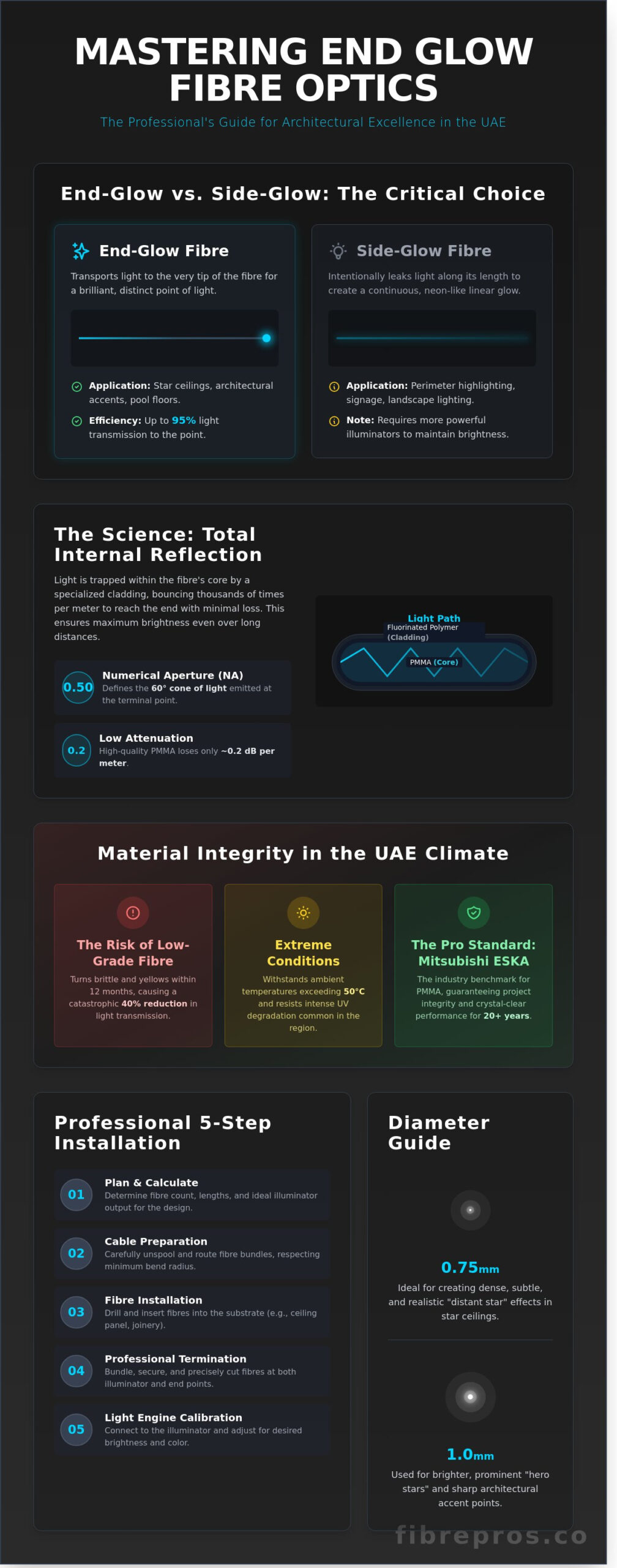
The choice between these two depends on the desired visual outcome. End-glow focuses light at the tip, providing a 95% efficiency rate for point-source applications. Side-glow fibre intentionally leaks light along its length to create a linear, neon-like glow. For a 10-meter run in a Dubai hotel lobby, end-glow is superior because it minimizes light loss over distance. Side-glow is better suited for perimeter highlighting, but it requires more powerful illuminators to maintain consistent brightness across the entire length.
Why PMMA Material Matters for UAE Projects
Material quality is the most significant factor in longevity. Mitsubishi ESKA remains the industry benchmark for PMMA due to its 20-year track record of durability. In the UAE, ambient temperatures in Jebel Ali warehouses or outdoor installation sites can exceed 50 degrees Celsius. High-grade PMMA resists UV degradation and maintains flexibility. Cheap alternatives often turn brittle and yellow within 12 months, leading to a 40% reduction in light transmission. Professional installers prioritize Mitsubishi ESKA to ensure the infrastructure survives the Middle Eastern climate without requiring costly replacements. It’s the only way to guarantee the project’s integrity over time.
How End Glow Fibre Works: The Science of Total Internal Reflection
Professional lighting design relies on the precise manipulation of light through physics. At the heart of every end glow fibre installation is the principle of Total Internal Reflection. This phenomenon occurs when light hits the boundary between the fibre core and its cladding at an angle steeper than the critical angle. Instead of passing through the surface, the light reflects back into the core. This process repeats thousands of times per metre, ensuring that photons delivered by the illuminator reach the tip with minimal leakage along the cable run.
Efficiency depends on the Numerical Aperture (NA), a dimensionless number that characterizes the range of angles over which the system can accept or emit light. A standard PMMA fibre typically features an NA of 0.50. This value determines the 60-degree cone of light spread at the terminal point. For B2B clients in Dubai, understanding attenuation is equally critical. High-quality PMMA strands lose approximately 0.2 dB per metre. In a 20-metre run, this results in a calculated 4 dB loss, requiring a high-output light source to maintain consistent brilliance at the fixture end.
The Anatomy of a Professional Fibre Optic Strand
Quality begins with the PMMA (Polymethyl Methacrylate) core. This material provides 92% light transmission, ensuring that the Kelvin temperature of your light source remains accurate at the output point. Surrounding this core is a thin layer of fluorinated polymer cladding. This cladding has a lower refractive index than the core, acting as a continuous mirror. While single-strand fibres offer precision for star ceilings, multi-strand cables, often containing 7 to 126 individual 0.75mm fibres, are the industry standard for high-intensity architectural accents where maximum lumen density is required.
Light Sources and Illuminators in the Middle East
The illuminator acts as the engine for the entire end glow fibre system. In the UAE, where ambient temperatures in utility voids can exceed 55°C, thermal management is a non-negotiable specification. Professional-grade LED illuminators utilize active cooling and oversized heat sinks to prevent thermal throttling. Modern systems integrate DMX512 or Bluetooth Mesh protocols, allowing for 16.7 million colour variations and precise twinkle effects. If you’re designing a complex installation, consult with specialist network technicians to ensure your hardware matches your environmental demands.
Selecting the Right Diameter: A Technical Guide for UAE Designers
Diameter serves as the most critical specification for visual impact and installation integrity. It dictates the light output per point and the physical flexibility of the strand. A 0.5mm fibre maintains a tight bend radius of approximately 5mm; however, a 3.0mm fibre requires a 30mm radius to prevent structural failure or light leakage. In the GCC market, designers typically specify diameters between 0.5mm and 3.0mm to meet the rigorous demands of luxury interior fit-outs.
Diameter vs. Application: Finding the Sweet Spot
Selecting the correct end glow fibre size depends on the intended atmosphere. For residential star ceilings in Dubai villas, 0.50mm to 0.75mm strands are the industry standard. These diameters create a realistic, pinpoint light source that mimics the natural night sky. Projects requiring high-visibility signage or task lighting in retail environments should utilize 1.0mm to 1.5mm strands for increased lumen delivery. Large-scale architectural focal points require 2.0mm or 3.0mm fibres. These thicker strands are designed to be paired with crystal end fittings, which refract the light to create a sophisticated chandelier effect in hotel lobbies.
Calculating Strand Counts for Large Projects
Accurate calculations prevent equipment failure. The capacity of an LED illuminator is limited by its port diameter. A standard 30mm port accommodates approximately 1,200 strands of 0.75mm fibre or 450 strands of 1.5mm fibre. Professionals often mix diameters, such as using 60% of 0.75mm, 30% of 1.0mm, and 10% of 1.5mm strands. This technique creates a 3D star ceiling effect with varied depths of field.
For high-ceiling penthouses in Downtown Dubai, cable length estimation is vital. Follow these steps for accurate planning:
- Measure the vertical distance from the ceiling to the illuminator location.
- Add the horizontal run across the ceiling grid.
- Include a 20% length buffer for every strand to allow for splicing and dressing at the light source.
- Ensure the end glow fibre is secured every 50cm to prevent sagging over time.
Precision in these technical details ensures the lighting system remains reliable and visually consistent throughout its 50,000-hour operational lifespan. FibrePros recommends testing all strand counts against the illuminator’s thermal threshold before final installation to guarantee peak performance.
How to Install End Glow Fibre: A Professional 5-Step Guide
Precision defines the difference between a high-end architectural feature and a failed installation. FibrePros follows a rigorous technical protocol to ensure every end glow fibre project meets Tier 1 standards for light transmission and durability.
Step 1 & 2: Planning and Threading
Success begins with calculating the bundle size against the illuminator’s port capacity. A standard 30mm port typically accommodates 400 strands of 0.75mm fibre. For a realistic celestial effect in Dubai residential projects, we map star density at exactly 20 to 40 points per square metre. When threading through joinery or ceiling panels, installers must maintain a minimum bend radius of 10 times the fibre diameter. Tight bends cause immediate light leakage and long-term attenuation.
- Adhesive Selection: Use only neutral-cure silicone or specialized PMMA-safe adhesives. Solvent-based glues will melt the polymer, destroying the light path.
- Cable Management: Group fibres into logical zones using Velcro ties rather than plastic zip ties to avoid crushing the core.
- Panel Prep: Pre-drill holes 0.1mm wider than the fibre diameter for a friction fit that doesn’t require excessive force.
Step 3, 4 & 5: Terminating and Polishing
Gather the fibres at the light source to create a consolidated “common end.” Use a professional hot knife or a dedicated fibre cutter to achieve a clean, 90-degree snap. If the cut angle deviates by more than 5 degrees, light entry efficiency drops by approximately 15 percent. For premium commercial installations, we integrate crystal end fittings to magnify the output and provide a finished architectural look. These fittings are essential for high-ceiling environments where light dispersion is critical.
During the final trim at the display surface, leave a 2mm protrusion if you require a wide-angle glow. Flush cutting is reserved for smooth, tactile surfaces like marble or high-gloss panels. Before final sealing, test the entire run with a 1000-lumen temporary light source. This allows technicians to identify any kinks or breaks that occurred during the threading process. It’s a vital quality control step that prevents costly rework after the panels are mounted.
Why Mitsubishi ESKA is the Preferred Choice for FibrePros
Mitsubishi ESKA stands as the industry benchmark for high-performance end glow fibre. Its superior light transmission allows designers to achieve 20% more brightness at the terminal point compared to standard generic fibres. This efficiency means you can use lower wattage illuminators, reducing total energy consumption across large-scale Dubai installations. Reliability is the primary concern for our B2B clients. Inferior polymers often turn brittle or yellow after 18 to 24 months of operation. Mitsubishi ESKA maintains its optical clarity for over a decade; it ensures the architectural intent remains intact long after the project’s completion.
FibrePros has supported the UAE lighting industry since 1995. We maintain a significant local inventory of Mitsubishi ESKA in Dubai to serve the immediate needs of contractors and interior specialists. This local availability eliminates the 4 to 6 week lead times typical of international shipping. Our team understands the specific thermal challenges of the Middle East climate and how they affect end glow fibre longevity. We provide the technical precision required for high-stakes environments where system failure isn’t an option.
The FibrePros Advantage in the GCC
- Technical Support: We assist with complex architectural specifications, ensuring every lux level meets the client’s specific requirements.
- Custom Assembly: Our workshop provides custom kit assembly for star ceilings and sensory rooms. We deliver pre-cut, harnessed bundles that reduce on-site installation time by 30%.
- Proven Results: We’ve built a track record in Dubai’s most prestigious hospitality projects, delivering specialized mastery in decorative lighting infrastructure.
Next Steps for Your Project
Precision starts with the right data. You can request a technical datasheet for Mitsubishi ESKA fibre to verify performance metrics against your project needs. Our engineers are available to consult on custom illuminator and fibre bundle configurations to ensure your system operates at peak efficiency. We don’t just supply components; we provide end-to-end solutions that guarantee reliability. Contact the Pros for your Dubai fibre optic requirements to secure a technical consultation and receive a detailed project estimate.
Precision Engineering for Your Next Lighting Project
Success in decorative lighting relies on technical precision and high-grade materials. Selecting the correct diameter for your end glow fibre ensures optimal light transmission, while following our professional 5-step installation protocol prevents common failure points in complex Dubai architectures. Since 1995, we’ve specialized in delivering these high-performance systems across the UAE. As an official supplier of Mitsubishi ESKA Plastic Optical Fibre, we provide components specifically engineered to withstand high-heat environments without degrading over time.
Our team brings nearly 30 years of local expertise to every project, ensuring your infrastructure meets global professional standards. We don’t just supply parts; we deliver end-to-end reliability for designers who demand excellence. Whether you’re planning a large-scale commercial installation or a bespoke residential feature, our technical mastery ensures your vision translates into a durable, high-impact reality. We’re here to help you navigate the complexities of optical physics and heat management. For detailed examples of how these systems perform in the region’s most challenging environments, explore our comprehensive fibre optic lighting case study UAE showcasing luxury solutions for extreme climates.
Ready to secure the technical foundation for your design? Request a Technical Consultation for Your Dubai Project and let’s build something exceptional together.
Frequently Asked Questions
Can I cut end glow fibre to any length?
Yes, you can cut end glow fibre to any specific length using a sharp blade or a dedicated hot knife. While the physical length is flexible, light transmission efficiency remains optimal up to 30 meters. Beyond this point, you’ll see a 10% to 15% reduction in brightness. Always ensure a 90 degree perpendicular cut to maximize light output at the termination point.
Is end glow fibre optic lighting safe for use in bathrooms and spas in Dubai?
Yes, end glow fibre is 100% safe for wet environments like Dubai spas and bathrooms. The strands carry only light and zero electrical current, which eliminates the risk of short circuits in humid conditions. You must house the LED light engine in a ventilated, dry area or a dedicated IP65 rated enclosure located at least 2 meters away from water sources.
How many fibres do I need for a standard 10sqm star ceiling?
A standard 10sqm star ceiling requires between 300 and 500 individual fibres to achieve a realistic celestial effect. We recommend a density of 30 to 50 points per square meter. Using a mix of 0.75mm and 1.5mm diameters creates depth, mimicking the varying magnitudes of real stars in the night sky. This distribution ensures a balanced, professional finish across the entire surface.
What is the lifespan of Mitsubishi ESKA fibre in the UAE heat?
Mitsubishi ESKA fibre features a service life exceeding 20 years when installed correctly in the UAE. It withstands operating temperatures up to 70 degrees Celsius, which is critical for ceiling voids in Dubai. The high grade PMMA material resists UV degradation, ensuring the light transmission remains within 95% of its original clarity over two decades of constant use. For precise thermal thresholds and bend radius requirements, refer to our comprehensive ESKA POF specifications technical guide for Dubai projects.
Do I need an electrician to install the fibre optic strands?
You don’t need a certified electrician to handle the fibre optic strands because they’re non-conductive components. However, a qualified professional must install the 240V power supply and the LED light source to comply with Dubai Municipality building codes. The strands themselves are passive elements that you can safely thread through panels without any specialized electrical training.
Can end glow fibre change colour?
Yes, end glow fibre changes colour based on the settings of the connected LED light engine. Most modern units utilize RGBW chips that provide over 16 million colour variations and dedicated 4000K white light. You can control these transitions via DMX512 protocols or mobile applications, allowing for synchronized lighting displays across large scale commercial installations in the hospitality sector.
What is the difference between glass and plastic (PMMA) optical fibre for lighting?
Plastic PMMA fibre is the industry standard for decorative lighting due to its flexibility and impact resistance. Unlike glass fibre, which becomes brittle and breaks at a 15 degree bend, PMMA can handle tight radii without snapping. PMMA also costs roughly 40% less than glass alternatives while providing superior light distribution for end-emitting applications in architectural projects.
How do I fix a broken fibre optic strand in an existing star ceiling?
You can’t effectively splice a broken strand mid-run without losing 50% of the light intensity. The professional solution involves pulling a new 0.75mm strand through the existing path or re-terminating the broken end if there’s enough slack. For minor surface nicks, applying a clear UV-curing resin can sometimes restore 80% of the original glow at the tip without a full replacement.