
In the 50-degree heat of a Dubai summer, a standard lighting system isn’t just a luxury; it’s a liability. You know that high-end projects in the Middle East demand more than just aesthetic appeal. They require infrastructure that survives extreme thermal stress. It’s frustrating when clients confuse data-grade fibre with lighting-grade materials, or when a star ceiling fails after 12 months because of poor heat management. Implementing the Best practices for Fibrepros ensures that luxury installations remain permanent assets rather than recurring maintenance headaches.
This guide helps you master the technical precision required for elite Middle Eastern developments. You’ll gain confidence in specifying Mitsubishi ESKA POF and understand why fibre remains the only 100% safe solution for wet areas like pools and spas. We’ll preview the Fibrepros Standard for heat-shielding light engines and the exact steps to deliver a flawless, long-lasting star ceiling that performs reliably in the most demanding environments.
Key Takeaways
- Identify the critical differences between data-grade glass and PMMA plastic optical fibre to ensure your architectural projects achieve superior light emission.
- Implement the best practices for Fibrepros to accurately match fibre diameters with high-CRI LED illuminators for optimal system integrity.
- Master essential installation techniques for the Middle East environment, including precise bend radius rules and strategic heat management in Dubai service zones.
- Establish a professional 12-month maintenance schedule to ensure the long-term performance and clarity of luxury lighting components.
- Leverage regional expertise and premium Mitsubishi ESKA POF inventory to deliver reliable, end-to-end lighting infrastructure across the GCC.
Decorative vs. Communications Fibre: Defining the Fibrepros Specialty
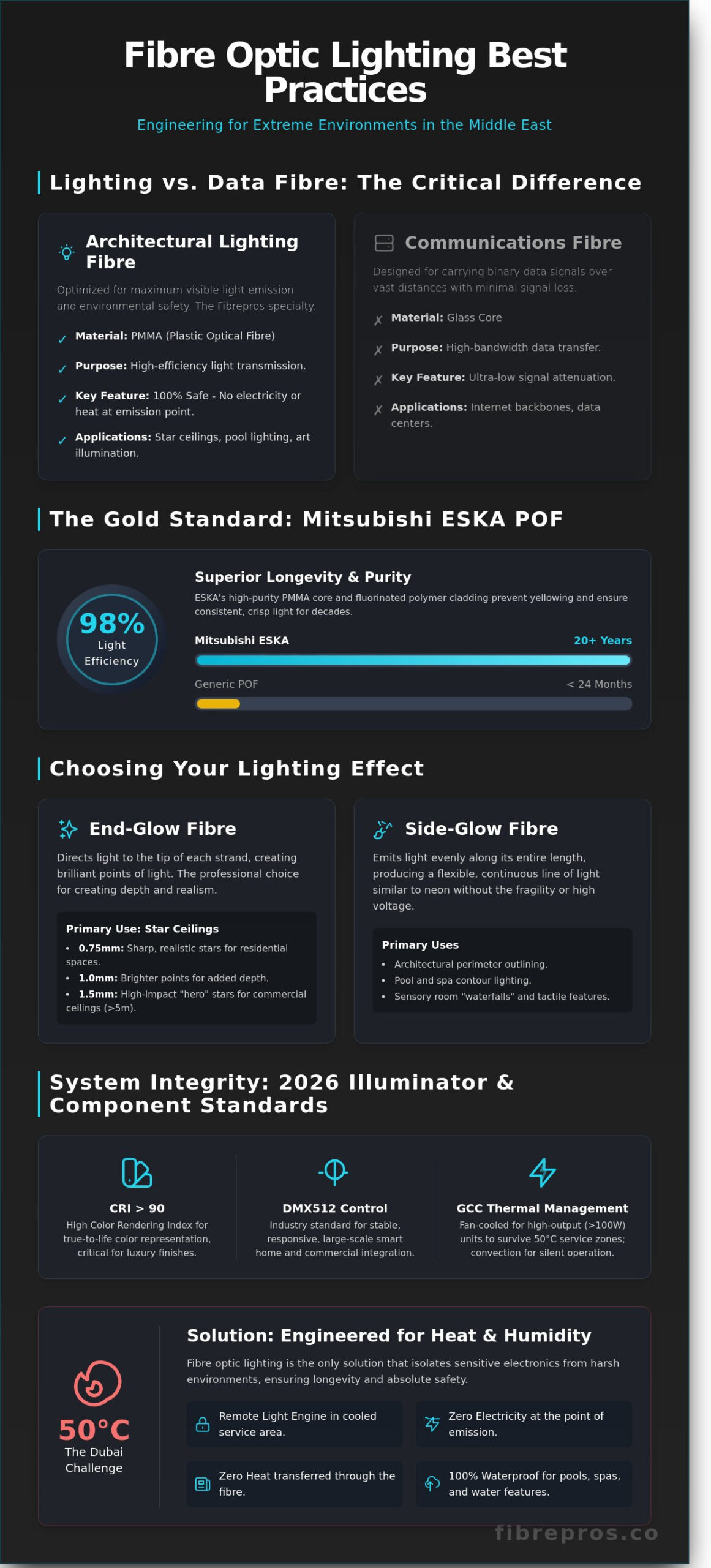
Most people associate fibre optics with high-speed internet and data centers. While the physics of how optical fibers work remains consistent across all applications, the materials and objectives differ significantly between telecommunications and architectural lighting. Communications fibre typically utilizes glass cores to carry binary data over kilometres. Fibrepros focuses exclusively on Plastic Optical Fibre (POF) made from high-grade Polymethyl Methacrylate (PMMA). This material prioritizes the efficient transmission of visible light rather than data bandwidth.
Safety is the most compelling reason to choose POF for luxury installations. Because the light source, known as the illuminator, is housed in a remote, ventilated location, the fibre cables themselves carry zero electricity. There’s no heat at the point of emission. This makes it the only viable solution for 100% waterproof pool lighting or illuminating heat-sensitive artwork in galleries. In the UAE market, implementing best practices for Fibrepros involves leveraging this safety profile to create immersive environments that traditional LEDs cannot match.
Our work across the Middle East highlights the versatility of this technology:
- Jumeirah Villa Star Ceilings: Creating celestial maps using thousands of individual fibre points.
- Burj Al Arab-Style Pools: Submerged perimeter lighting that requires zero underwater electrical maintenance.
- Commercial Facades: Linear accents that withstand 50-degree Celsius ambient temperatures without degrading.
Following best practices for Fibrepros ensures that these installations maintain their brilliance for 20 years or more without the "yellowing" common in inferior products.
What is Mitsubishi ESKA Plastic Optical Fibre?
Architects in Dubai specify Mitsubishi ESKA because it represents the gold standard in light transmission. Generic plastic fibres often use low-grade resins that degrade within 24 months of installation. ESKA POF features a high-purity PMMA core wrapped in a thin layer of fluorinated polymer cladding. This specific construction ensures a 98% light transmission efficiency. The high-purity core is essential for preventing the light from shifting toward a yellow or green hue over long distances, a critical requirement for maintaining the crisp, white light expected in high-end hospitality projects.
End-Glow vs. Side-Glow: Tactical Best Practices
Choosing the correct cable type is the foundation of a successful project. End-Glow fibre directs light specifically to the tip of the strand. It’s the professional choice for star ceilings, where we use diameters ranging from 0.75mm to 1.5mm to create depth and varying magnitudes of "stars."
Side-Glow fibre uses a treated surface to allow light to leak evenly along its entire length. This creates a neon-like effect without the fragile glass or high voltage. It’s ideal for outlining architectural perimeters or creating tactile "waterfalls" in sensory rooms. Mixing both types in a single 50-square-meter installation allows for complex, multi-layered lighting designs that provide both ambient glow and sharp focal points.
Component Selection: Best Practices for System Integrity
Selecting the right components is the foundation of a reliable fibre optic installation. Best practices for Fibrepros dictate that fibre diameter must be matched precisely to the viewing distance and intended atmosphere. For standard residential star ceilings, 0.75mm PMMA fibre provides a sharp, realistic point of light. In commercial lobbies with ceiling heights exceeding 5 metres, 1.5mm fibre is required to maintain visual impact. Using the wrong diameter results in either a cluttered, “noisy” ceiling or light points that disappear into the background.
LED Illuminator Standards for 2026
The illuminator is the engine of the system. For 2026, professional installations in Dubai focus on high-fidelity light engines with a Color Rendering Index (CRI) of 90 or higher. While Bluetooth Mesh 5.0 offers convenience for residential users, DMX512 remains the industry standard for large-scale smart home integration due to its superior stability and response time. Thermal management is equally vital. In the GCC, fan-cooled illuminators are necessary for high-output 100W units to prevent premature LED degradation, whereas convection-cooled units are preferred for silent operation in bedrooms.
The ideal lumen-to-fibre ratio for star ceilings is 50 lumens of source output for every 1.5mm of active fibre bundle surface area. Adopting energy-efficient lighting design principles ensures that these high-output systems don’t place unnecessary strain on building power grids or HVAC systems. It’s a balance of performance and long-term operational cost.
Choosing Fixtures for Harsh Environments
Dubai’s coastal conditions present unique challenges. Salinity levels in the region can reach 40,000 parts per million, which quickly corrodes standard hardware. 316-grade stainless steel is mandatory for all pool and outdoor fixtures to prevent pitting and structural failure within the first 12 months of service. Crystal end fittings are the professional’s choice for luxury chandelier effects, as they diffuse light into a controlled 60-degree spread while concealing the raw fibre ends. These fittings also provide a physical barrier against dust and moisture ingress.
- 316 Stainless Steel: Essential for coastal and underwater durability.
- Crystal Fittings: Elevates aesthetics and improves light diffusion.
- Sensory Kits: Must meet EN60598 safety standards for use in clinics.
Precision in component selection ensures the system performs as intended from day one. If you’re planning a complex installation, a technical consultation can help verify your hardware specifications against local environmental demands. Best practices for Fibrepros involve checking every fixture against the specific IP68 or IP65 requirements of the zone before the first fibre is ever cut.
Installation Excellence: The Middle East Environmental Standard
Delivering high-performance lighting in the UAE requires a shift from standard European methods to localized protocols. Adhering to the best practices for Fibrepros ensures that infrastructure survives 50°C ambient temperatures and high humidity. Precision starts with the physical layout. Technicians must eliminate the “spaghetti effect” by utilizing dedicated cable trays and Velcro ties instead of plastic zip ties. Plastic ties often exert uneven pressure, causing micro-bends that result in a 15% to 20% drop in light transmission. Every bundle should be labeled at 2-meter intervals to ensure long-term serviceability in complex ceiling voids.
Mastering the Bend Radius and Cutting
Clean termination is the foundation of light efficiency. A 90-degree cut isn’t just a suggestion; it’s a technical requirement. Using a specialized cutting tool for ESKA POF, such as the Mitsubishi Rayon cutter, ensures the fiber end is perfectly flat. This prevents light scattering at the junction. For the bend radius, follow the 10x rule: the curve must be at least 10 times the diameter of the fiber. If you’re installing a 1.5mm fiber, your radius shouldn’t drop below 15mm. Tighter bends create stress fractures that permanently degrade the core.
Managing Heat in the UAE Climate
Heat is the primary enemy of LED illuminators. In Dubai, attic temperatures frequently exceed 50°C, which can trigger thermal shutdown in under 30 minutes. We position all illuminators in dedicated “service zones” that are climate-controlled or heavily ventilated. Heat sinks must be oriented vertically to allow for natural convection. For pool installations, we recommend remote-located illuminators placed in a plant room up to 15 meters away. This removes the electrical components from the humid pool environment and simplifies maintenance.
Waterproofing protocols are equally vital for the best practices for Fibrepros. Underwater fixtures require an IP68 rating and specialized epoxy resin seals to prevent moisture ingress. We use 316-grade stainless steel housings to prevent corrosion from saline pool water. Total system integrity depends on these small, technical details. By isolating the light source from the water through fiber optics, we provide a solution that is 100% electrically safe for swimmers while maintaining elite aesthetic standards.
Maintenance and Longevity for Luxury Lighting Systems
The “zero maintenance” label often applied to fiber optics is a technical fallacy. While the fibers don’t carry electricity, the illuminators and terminations require consistent care to prevent performance degradation. Following the best practices for Fibrepros involves a comprehensive system check every 12 months to protect your investment. High-end installations in coastal environments like the Palm Jumeirah or the Red Sea face 35% higher rates of salt-induced corrosion on external enclosures. Without professional intervention, salt deposits compromise the seals of illuminator housings within 24 months, leading to internal component failure.
If you notice a 20% drop in lumen output, check the LED driver first. Modern drivers usually fail before the fiber bundle itself. However, if the light shift is localized to specific strands, the common end has likely suffered thermal damage. Best practices for Fibrepros dictate that we analyze the harness face for discoloration before replacing hardware, as a simple re-polish often resolves the issue without the cost of a full harness replacement.
Annual Inspection Checklist
- LED fan operation: Check cooling fans for dust accumulation; a 2mm layer of dust can increase operating temperatures by 15 degrees Celsius.
- Underwater integrity: Inspect 316-grade stainless steel fittings for tea-staining or pitting caused by chemical imbalances in pool environments.
- Control responsiveness: Verify DMX signal stability and wireless remote responsiveness from a minimum distance of 15 meters to ensure zero latency.
Cleaning and Performance Optimization
Apply 99% isopropyl alcohol to a lint-free swab to clean the common end of the fiber bundle. This removes microscopic oils that cause “hot spots” and potential melting. Poor initial installations often result in “burnt” ends where the fiber has fused due to air gaps between the LED and the harness. If this occurs, our team re-terminates and polishes the bundle to restore 100% of the original light output. Dust accumulation on the illuminator lens reduces light transmission efficiency by up to 15% over a single year.
To ensure your system maintains its peak performance, book a professional maintenance audit with our technical team today.
Partnering with Fibrepros: Why Regional Expertise Matters
Since 1995, Fibrepros has served as the technical backbone for high-end fiber optic installations across the GCC. We maintain the largest inventory of Mitsubishi ESKA Plastic Optical Fiber (POF) in the Middle East, ensuring immediate availability for urgent infrastructure needs. Relying on local stock eliminates the 6-week lead times typical of international procurement. Adhering to the Best practices for Fibrepros involves choosing materials that withstand the Middle East’s specific climate conditions, a core component of our quality assurance process for nearly three decades.
Standard off-the-shelf solutions rarely accommodate the architectural complexity of modern Dubai projects. We prioritize custom kit assembly over generic products to ensure every installation meets exact site requirements. Following the Best practices for Fibrepros involves tailoring fiber counts and lengths to the specific dimensions of a project, which prevents signal loss and material waste. Our regional experience ensures that every component, from the light source to the end-fitting, is optimized for peak performance in high-temperature environments.
Bespoke Design and Engineering Support
Our engineering team provides end-to-end support for complex technical lighting schematics. We’ve mastered everything from intricate star ceiling layouts to specialized underwater lighting systems that require strict IP68-rated seals. The “Pros” in our name represents a commitment to technical precision from the design phase through to site delivery. A recent case study includes our work on luxury hospitality landmarks in Dubai and Doha, where we integrated over 15,000 points of light across multiple high-traffic zones using specialized Mitsubishi ESKA fibers to create a seamless guest experience.
Next Steps: Requesting a Project Quote
To provide an accurate fiber optic lighting estimate, our team requires specific technical details to ensure the system’s longevity. We need your CAD drawings, desired point density, and specific control requirements, such as DMX or DALI integration. We provide wholesale opportunities and bulk pricing for UAE lighting contractors and interior designers looking to scale their operations with reliable components. It’s time to secure your supply chain with a partner that understands the regional market. You should consult with the Fibrepros team for your 2026 project to ensure your technical requirements are met with precision and expert care.
Future-Proof Your Lighting Infrastructure
Achieving technical excellence in Dubai’s luxury sector requires a shift from generalist approaches to specialized mastery in non-communications optical fibre. The best practices for Fibrepros focus on three critical pillars: selecting high-grade components, adhering to the Middle East Environmental Standard, and ensuring rigorous maintenance protocols. Since 1995, we’ve refined these processes to protect your investment against the region’s extreme heat and humidity. As an Authorized Mitsubishi ESKA Distributor, we provide the technical precision needed for systems that demand zero downtime and maximum aesthetic impact.
Our 29 years of local experience ensures every installation meets the elite craftsmanship standards expected in the UAE. We don’t just install lighting; we build invisible but vital infrastructure that defines the city’s skyline. By choosing a partner with specialized expertise, you guarantee that your project benefits from nearly three decades of field-tested reliability. It’s time to move beyond standard solutions and embrace a higher level of technical performance. We’re ready to help you set a new benchmark for excellence in architectural design.
Secure the Gold Standard in Fibre Optics: Contact Fibrepros Today
We look forward to bringing your vision to life with unmatched precision and expertise.
Frequently Asked Questions
What are the best practices for installing star ceilings in Dubai villas?
Installers should use high-density PMMA fiber with at least 50 points per square meter to achieve a realistic celestial effect. Best practices for Fibrepros involve using a mix of 0.75mm and 1.5mm fibers to create varying star magnitudes. It’s vital to house the light engine in a ventilated area, as attic temperatures in the UAE can reach 60 degrees Celsius, which can damage unshielded components.
Can I use plastic optical fibre for pool lighting in the UAE?
You can definitely use PMMA plastic optical fiber for pool lighting because it’s non-conductive and carries no heat. We recommend 10mm solid-core fiber for perimeter lighting to ensure a uniform glow. This material withstands the high chlorine levels and 40-degree Celsius water temperatures found in local pools. It’s a reliable solution that eliminates the risk of electrical leaks in the water.
How long does a Mitsubishi ESKA fibre optic system typically last?
A Mitsubishi ESKA system typically lasts over 20 years when the fiber is protected from direct UV exposure. The PMMA core is engineered for durability, showing less than a 3% increase in light attenuation over a decade of use. While the fiber remains functional for decades, you’ll likely need to replace the LED light source after 50,000 hours of operation to maintain peak brightness.
Is fibre optic lighting safer than LED for underwater use in Dubai?
Fibre optic lighting is much safer than traditional LEDs because there are no electrical cables near the water. The light engine stays in a dry plant room up to 15 meters away, sending only light through the cables. This setup removes the 12V or 24V shock risk entirely. It’s the preferred choice for high-end villas where safety and long-term maintenance are the primary concerns.
What is the maximum length a fibre optic cable can run without losing light?
The maximum effective length for a standard PMMA fiber run is 20 meters before you notice a drop in intensity. Beyond 20 meters, light loss can exceed 15% per additional meter. If your project requires a 40-meter run, we recommend placing a light engine at both ends. This ensures the 150-watt output remains consistent across the entire length of the architectural feature.
Do I need a specialized electrician for fibre optic lighting installation?
You need a technician specifically trained in fiber termination rather than a general domestic electrician. While a standard electrician handles the 230V power feed, the “Best practices for Fibrepros” require specialized hot-knife cutting and polishing tools. A poorly cut fiber end can reduce light transmission by 40%. Specialized Pros ensure every strand is perfectly coupled to the illuminator for maximum efficiency.
How does the Dubai heat affect the performance of LED illuminators?
Ambient temperatures exceeding 45 degrees Celsius can cause LED drivers to fail if they aren’t properly cooled. We use illuminators with internal cooling fans and thermal sensors that trigger at 70 degrees Celsius to prevent burnout. Placing the light engine in a climate-controlled room extends its life by 60%. This prevents the dimming issues often seen with low-quality hardware in the Middle East.
What is the difference between end-glow and side-glow fibre for architectural use?
End-glow fiber focuses 100% of the light at the tip for pinpoint star effects, whereas side-glow fiber leaks light along its entire length. End-glow typically uses 0.75mm strands for ceiling displays. Side-glow uses a thicker 10mm or 12mm cable with a specialized jacket to create a neon-like appearance. Both types are inert and waterproof, making them ideal for highlighting 30-meter building perimeters or garden paths.