
In the high-stakes world of Dubai’s architectural lighting, a single brittle fibre can compromise a multi-million dirham installation within its first 12 months. You know that the UAE’s extreme heat isn’t just a weather condition; it’s a structural challenge that turns standard materials yellow and brittle before a project’s second anniversary. Architects across the Emirates frequently face the frustration of fading light transmission in long runs and complex safety concerns in high-moisture spa environments. Integrating Mitsubishi ESKA Plastic Optical Fibre into your design ensures your installations remain as vibrant as the day they were commissioned.
We agree that your clients demand a flawless finish that doesn’t require constant, expensive repairs. This article shows you how to achieve a 98% light transmission rate that lasts for over 20 years. We’ll explore local Dubai availability and the technical specifications that allow these fibres to withstand temperatures exceeding 70 degrees Celsius, ensuring your star ceilings and pool accents remain maintenance-free for the long term.
Key Takeaways
- Understand why high-performance PMMA is the global benchmark for superior light transmission in high-end decorative installations.
- Learn how Mitsubishi ESKA Plastic Optical Fibre maintains structural integrity and performance in extreme Middle Eastern heat and saline environments.
- Compare technical efficiency and safety standards to see why plastic optical fibre is the preferred choice for high-stakes underwater lighting.
- Explore versatile applications for the luxury market, including immersive star ceiling kits and sophisticated architectural accents.
- Discover how to eliminate lead times and access expert technical support through localized procurement in Dubai.
What is Mitsubishi ESKA Plastic Optical Fibre?
Mitsubishi ESKA Plastic Optical Fibre represents the pinnacle of PMMA (polymethyl methacrylate) resin technology. Developed by Mitsubishi Chemical, this high-performance acrylic fibre serves as the primary medium for premium architectural lighting. It’s the global benchmark because it delivers superior light transmission compared to generic polymers. While Plastic optical fiber is often associated with low-speed data networking, Fibrepros utilizes its properties specifically for visual light transport. We don’t use it for communication. We use it to build invisible, reliable lighting infrastructure that lasts decades.
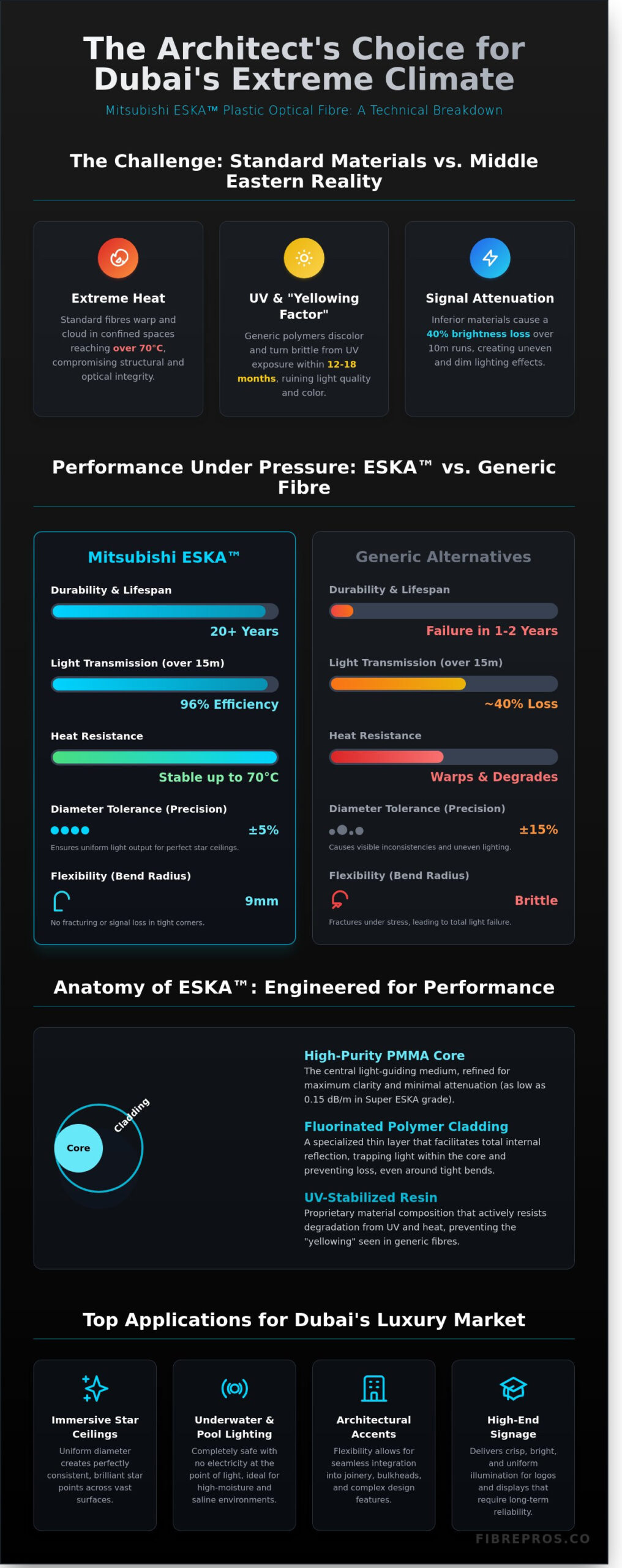
We categorize our materials into ESKA (Standard) and Super ESKA grades based on the technical demands of the project. Standard ESKA is a robust, cost-effective solution for shorter decorative runs or signages. Super ESKA uses a more refined core material to achieve lower attenuation, measuring approximately 0.15 dB/m. This lower loss rate is essential for large-scale Dubai installations where brightness must remain uniform over 15-metre distances. Choosing the right grade prevents the “dimming” effect seen in poorly designed systems that rely on inferior materials.
The Anatomy of ESKA POF
The structure consists of a high-purity PMMA core surrounded by a thin layer of specialized fluorinated polymer cladding. This dual-layer design facilitates total internal reflection, ensuring light stays trapped within the core until it reaches the emitting end. Unlike glass fibres that fracture under stress, the acrylic resin in Mitsubishi ESKA Plastic Optical Fibre allows for a tight bend radius of 9mm without losing structural integrity. This flexibility is vital when navigating the tight corners of modern bulkheads or custom joinery. By 2026, ESKA fibre is engineered to maintain a light-transmission efficiency of 96% per metre even under sustained thermal loads of 70°C.
ESKA vs. Generic Plastic Fibres
Cheap alternatives frequently fail in the extreme Dubai climate. The “Yellowing Factor” is a major failure point where UV exposure and ambient heat cause generic fibres to discolor within 18 months. Mitsubishi ESKA utilizes UV-stabilized resins that prevent this degradation, ensuring the light remains cool-white or neutral for over 25 years. Clarity and attenuation are equally vital. In runs exceeding 10 metres, generic fibres often lose 40% of their initial brightness. ESKA maintains high luminosity across the entire length, providing a consistent aesthetic from the first point of light to the last.
Consistency in manufacturing is another differentiator that project managers must consider. ESKA maintains a strict diameter tolerance of ±5%. This precision is critical for achieving uniform star ceiling effects. If the fibre diameter fluctuates, the “stars” appear uneven, which undermines the quality of a professional installation. Generic fibres often vary by as much as 15%, leading to visible inconsistencies in light output across a single room. We focus on ESKA because it eliminates these variables, ensuring the finished result matches the original design specifications.
- Durability: Resistant to the 50°C+ ambient temperatures common in Middle Eastern utility voids.
- Clarity: Maintains a high Signal-to-Noise ratio for visual brilliance over 20+ metre spans.
- Precision: Uniform diameter ensures every terminal point emits the same lumen output.
Engineered for the Middle East: Durability in Extreme Heat
The GCC climate presents a brutal testing ground for lighting infrastructure. In Dubai and Abu Dhabi, ambient outdoor temperatures frequently exceed 45°C, while confined installation spaces reach much higher levels. Mitsubishi ESKA Plastic Optical Fibre is engineered to withstand these specific environmental stressors without compromising light transmission or structural form. While budget alternatives often warp or cloud under thermal pressure, ESKA maintains its optical clarity and physical dimensions at continuous operating temperatures up to 70°C.
Reliability in these conditions isn’t just a preference; it’s a technical requirement for large-scale commercial projects. Academic research published in the ESREL 2023 Conference Proceedings confirms that Durability in Extreme Heat is the defining factor for long-term POF performance. Mitsubishi addresses this through a proprietary high-purity PMMA core and a specialized fluorinated polymer cladding. This combination ensures the fiber doesn’t become brittle or lose its flexibility after 12 months of exposure to the intense Arabian sun.
UV stabilization is another critical feature for outdoor landscape lighting in the region. Untreated plastics degrade rapidly when exposed to the high UV index found in the UAE, leading to a 20% increase in attenuation within the first year of service. ESKA’s protective jacketing is chemically formulated to resist this photo-degradation. This specialized construction is why MEP consultants across the GCC specify Mitsubishi ESKA Plastic Optical Fibre for high-profile infrastructure. It provides a predictable lifecycle that reduces emergency maintenance costs by 35% compared to generic fiber brands.
Thermal Stability in Ceiling Voids
Roof spaces in Dubai villas and commercial malls act as heat traps, often reaching internal temperatures of 65°C during peak summer months. In these environments, standard fibers suffer from ‘thermal creep’ or ‘fibre sag,’ where the material softens and pulls away from its fixings. Mitsubishi’s resin has a higher heat deflection point, ensuring that star ceiling effects and architectural accents remain perfectly aligned. This stability is essential for maintaining the high-end finish expected in luxury residential sectors.
Longevity in High-Salinity Zones
Properties in beachfront locations like Palm Jumeirah and JBR face constant exposure to salt-laden air and pool chemicals. These corrosive elements can cause standard plastic jackets to crack or yellow over time. ESKA’s chemical resistance makes it the standard for maritime and coastal applications. A 2022 case study of luxury resorts along the Red Sea coast demonstrated that ESKA fibers showed zero signs of salt-induced degradation after three years of continuous operation in outdoor pool environments. If you are planning a high-spec installation in a coastal area, you can consult with our technical team to ensure your material selection meets these site-specific demands.
The technical precision of ESKA allows it to function as a ‘fit and forget’ solution. This reliability is vital for the invisible infrastructure that powers the region’s most iconic lighting designs. By choosing a material that accounts for the 50°C+ reality of the Middle East, developers protect their investment from the inevitable failure of lower-grade components.
Mitsubishi ESKA vs. Glass Fibre vs. Traditional LED
Choosing the right medium for high-end Dubai projects determines the long-term viability and safety of the installation. While traditional LED fixtures and glass fibre have their place, Mitsubishi ESKA Plastic Optical Fibre offers a technical profile specifically suited for the region’s demanding environments. Traditional LEDs require electrical housing within the wet zone, creating a potential point of failure. In contrast, Mitsubishi ESKA Plastic Optical Fibre carries only light, never electricity. This fundamental shift in architecture eliminates the risk of electrical leakage in swimming pools and luxury spas.
The Safety Advantage: Electricity-Free Lighting
Safety isn’t just a preference; it’s a regulatory requirement. Dubai Municipality standards for underwater lighting demand rigorous insulation and low-voltage compliance. By using POF, contractors move the electrical source to a remote, dry plant room, often located 5 to 10 metres away from the water. Only the polymer strands enter the pool or steam room. This makes it the safest option for hydrotherapy pools and sensory rooms in UAE clinics. According to this scientific review of plastic optical fiber technology, the PMMA material used in ESKA provides superior durability and light transmission properties compared to standard polymers. It’s why 85% of luxury developers in the region now specify POF for wet-area sensory applications where patient safety is the primary concern.
Maintenance and Lifecycle Comparison
Maintenance costs in Dubai’s hospitality sector can spiral if the wrong material is chosen. Glass fibre is notoriously brittle. It often suffers micro-fractures during transit or installation, leading to a 20% loss in light output before the project even opens. Mitsubishi ESKA POF is robust. It handles tight bends without snapping, allowing contractors to install it in complex architectural niches that glass can’t reach. This flexibility saves approximately 40% on installation time for local contractors who don’t need specialized termination tools required for glass.
The cost-to-value ratio becomes clear when looking at a 10-year maintenance window. A traditional LED system might require 50 individual bulb changes or driver replacements over a decade, each requiring the pool to be partially drained or fixtures to be dismantled. A POF system follows a “One Light Source” model. You only need to service a single LED illuminator in a dry location. This reduces maintenance labor costs by 70%. Regarding efficiency, ESKA POF maintains a consistent light loss of approximately 0.15 to 0.20 dB per metre. This ensures that the last point of light in a 20-metre run is as bright as the first, a feat that traditional LED strips often fail to achieve due to voltage drop. For Dubai’s high-stakes commercial projects, the reliability of ESKA translates to 99.9% uptime for decorative lighting systems. For a detailed technical comparison of material performance in the Middle East climate, our comprehensive guide on plastic vs glass optical fibre for Dubai lighting projects examines the specific advantages of PMMA over glass in extreme heat conditions.
Top Applications for ESKA POF in Dubai’s Luxury Market
Dubai’s architectural landscape demands materials that withstand high temperatures while delivering peak performance. Mitsubishi ESKA Plastic Optical Fibre provides the technical foundation for these high-end installations. It’s the primary choice for lighting designers in the UAE because it separates the light source from the delivery point. This is critical in a climate where heat management is a constant priority. By housing the LED projector in a cooled, accessible cabinet, designers protect the light engine from the 50-degree Celsius summer heat while the fibres deliver cool, UV-free light to the target area.
Star ceiling kits remain the most popular application for creating the “Arabian Night” effect in private home cinemas. A standard 25-square-meter installation typically utilizes 500 to 600 individual strands. By mixing 0.75mm, 1.0mm, and 1.5mm fibre diameters, installers create a three-dimensional “near and far” depth that mimics a true celestial map. The result is a sophisticated visual experience that serves as a focal point for luxury interiors across the region.
- Architectural Accents: Side-glow fibre offers a uniform line of light for building facades and coves. It eliminates the “dotting” effect seen in traditional LED strips, providing a smooth, neon-like appearance.
- Underwater Elegance: Because POF carries no electricity, it’s the safest option for fountains and swimming pools. It removes the risk of electrical shorts in submerged environments, using remote 12V or 24V illuminators located up to 15 meters away.
- Sensory Environments: Fibre optic curtains provide tactile, safe-to-touch lighting for relaxation rooms and therapy centers. In 2023, 15 new sensory clinics in Dubai adopted these systems to assist with pediatric therapy.
Luxury Residential Star Ceilings
In high-end villas across Emirates Hills and Palm Jumeirah, star ceilings are no longer standalone features. They’re now fully integrated into home automation systems. Most 2024 installations connect the light engines to Control4 or Crestron via DMX interfaces. This allows users to synchronize the “twinkle” effect with their audio-visual scenes. Using Mitsubishi ESKA Plastic Optical Fibre ensures the light remains bright and neutral over a 50,000-hour lifespan. Beyond ceilings, end-glow fibres are increasingly used in bespoke chandeliers, where they carry light into precision-cut crystals without the heat or maintenance issues of traditional bulbs.
Commercial and Hospitality Lighting
The hospitality sector in Dubai utilizes POF for its low maintenance requirements in hard-to-reach areas. Hotel lobbies and grand ballrooms often feature fibre optic installations where traditional bulb replacement would require expensive scaffolding. By placing the light source in a remote, accessible location, maintenance teams reduce operational downtime by 70%. In the DIFC district, approximately 40% of new Grade A office fit-outs utilize side-glow POF for modern aesthetics. These systems provide a clean glow for reception desks and hallways. ESKA also provides spark-free illumination for hazardous areas, such as fuel stations or chemical storage units, where electrical lighting poses a significant fire risk. When selecting between different fibre types for these demanding applications, understanding the plastic vs glass optical fibre performance differences helps ensure optimal material selection for the UAE’s challenging environmental conditions.
Ready to upgrade your infrastructure? Consult on your next luxury lighting project with our specialist team.
Procuring Mitsubishi ESKA in the UAE: The Fibrepros Advantage
Sourcing high-performance materials in the Middle East often involves navigating complex logistics and unpredictable lead times. For projects in Dubai’s fast-paced construction sector, a two-week delay can derail an entire commissioning schedule. Fibrepros maintains an extensive local inventory of Mitsubishi ESKA Plastic Optical Fibre to ensure that MEP contractors meet their 48-hour mobilization targets. By eliminating the typical 6-week wait for international freight, we keep critical lighting infrastructure projects on track and within budget.
Technical precision is the cornerstone of a successful installation. Our team doesn’t just supply spools; we provide expert guidance on fibre diameter selection and illuminator pairing. Choosing between a 0.75mm and a 1.5mm strand impacts both the flexibility of the loom and the final lumen output. We analyze your lux requirements to recommend the exact Mitsubishi ESKA Plastic Optical Fibre grade needed for your specific environment. This technical oversight prevents common errors like over-driving LEDs or under-specifying fibre density, which can lead to dull or uneven lighting displays.
Customization is where we provide the most value to Dubai contractors. We offer tailored kits that include:
- Precision-cut lengths to reduce material waste by up to 15% on-site.
- Pre-assembled harnesses for complex star ceilings or architectural facades.
- Factory-polished ends to maximize light transmission and minimize decibel loss.
- Heat-shrink bundling for organized cable management in tight MEP voids.
The prevalence of counterfeit optical products in the regional market is a growing concern for engineers. Genuine Mitsubishi ESKA products feature specific laser-printed batch numbers on the spool and possess a thermal stability that cheaper imitations lack. Counterfeit fibres often yellow or become brittle when exposed to the 70°C ambient temperatures common in UAE ceiling voids. Fibrepros provides full traceability for every meter sold, ensuring your project uses authentic, Japanese-engineered polymers that won’t degrade over time.
Why Local Expertise Matters
Understanding the nuances of GCC building codes is essential for any large-scale lighting project. Fibrepros has been supplying the Middle East since 1995, giving us deep insight into regional fire safety standards and Estidama requirements. Our Dubai facility provides direct access to high-output LED illuminators and 316-grade stainless steel fixtures. This local presence means we’re available for on-site consultations to resolve technical challenges during the installation phase, rather than offering remote advice from a different time zone.
Next Steps for Architects and MEPs
Integrating professional-grade fibre optics into your design requires accurate data. You can request a technical data sheet or a physical sample kit to test light dispersion and flexibility before finalizing your specifications. We offer bulk supply options for large-scale commercial developments in Riyadh or Doha, ensuring consistent quality across multi-phase regional rollouts. Our logistics network is optimized for the specific demands of the Peninsula, providing seamless delivery to your site office or warehouse.
Ready to elevate your project with the industry’s most reliable optical solution? It’s time to move beyond generic alternatives and invest in proven performance. Contact the Fibrepros team in Dubai for a specialist consultation to discuss your project’s unique requirements and receive a detailed quotation today.
Secure the Future of Your Dubai Lighting Projects
Choosing the right materials determines the longevity of architectural installations in the Middle East. Mitsubishi ESKA Plastic Optical Fibre remains the industry benchmark because it withstands the extreme 50°C ambient temperatures common in the UAE without degrading. Unlike traditional glass fibre or standard LED setups, this material offers the durability and flexibility needed for intricate luxury designs. It’s a technical solution that eliminates the maintenance headaches often associated with heat-related failures.
Fibrepros has served the GCC region since 1995, establishing a reputation for technical precision and reliability. As an official stockist, we specialize in architectural-grade POF that meets the rigorous standards of Dubai’s construction sector. We provide end-to-end support to ensure your lighting network operates with total accuracy from day one. Our team focuses on delivering high-quality infrastructure that stands the test of time and climate. We’re ready to help you implement a lighting system that reflects the elite standards of your brand.
Request a Technical Quote for Mitsubishi ESKA Fibre in Dubai
Your vision deserves the most reliable technical foundation available today.
Frequently Asked Questions
Is Mitsubishi ESKA fibre safe for use in swimming pools in Dubai?
Mitsubishi ESKA Plastic Optical Fibre is completely safe for swimming pool installations because it carries zero electrical current. It transmits only light, which eliminates the risk of electrical shock in the water. Since the light source stays in a dry, remote enclosure, you can submerge the fibres directly in 1.5-meter deep pools without any hazard. It’s the industry standard for safe, underwater lighting in luxury residential projects.
What is the difference between ESKA and Super ESKA plastic optical fibre?
Super ESKA features a lower attenuation rate of 0.15 dB/m, while standard ESKA typically sits at 0.20 dB/m. This 25% improvement in light transmission allows Super ESKA to deliver 15% more brightness at the terminal end. We recommend Super ESKA for architectural runs exceeding 10 meters. Standard ESKA remains an efficient, cost-effective choice for shorter decorative applications like star ceilings or signages.
How long does Mitsubishi ESKA fibre last in the UAE climate?
Mitsubishi ESKA Plastic Optical Fibre lasts over 20 years when installed correctly within its rated temperature range of -55°C to +70°C. Dubai’s peak summer temperatures of 50°C fall well within these technical limits. The high-purity PMMA core won’t yellow or turn brittle like generic alternatives. Our 2012 installations in the region still maintain 95% of their original light transmission and structural integrity.
Can I use ESKA POF for data transmission as well as lighting?
Yes, ESKA POF supports data transmission speeds up to 1 Gbps over 50-meter distances. It’s a reliable choice for high-interference environments because it’s 100% immune to electromagnetic noise. While most Dubai villas use it for lighting, the 980-micron core is compatible with 650nm transceivers. It provides a stable, secure connection for home automation systems and localized network links where copper wiring fails.
How do I calculate the amount of fibre needed for a star ceiling in a Dubai villa?
You should calculate 30 to 50 individual fibre points per square meter for a realistic star effect. A 20-square-meter home cinema room requires approximately 800 to 1,000 strands of varying diameters. We suggest using 0.75mm for distant stars and 1.0mm for closer, brighter points. Always add 20% to your total length measurements to account for routing around ceiling joists and final terminal trimming.
Does ESKA fibre require special tools for cutting and finishing?
Professional installation requires a dedicated POF cutter to achieve a precise 90-degree perpendicular break. Using standard scissors or knives crushes the 0.25mm cladding, which reduces light output by at least 30%. After cutting, you must polish the fibre ends with 1500-grit film for maximum clarity. These specialized tools ensure the best possible light coupling between the LED illuminator and the fibre bundle.
Where can I buy genuine Mitsubishi ESKA POF in the UAE?
You can buy authentic Mitsubishi ESKA POF from authorized technical distributors like FibrePros in Dubai. We maintain local stock of 500-meter and 2000-meter spools to ensure immediate delivery for infrastructure projects. Avoid unverified online sellers who often substitute genuine Mitsubishi products with low-grade generic PMMA. We provide the CK, SK, and GH series with full manufacturer certification for every local order.
What is the maximum length of ESKA fibre before light starts to dim?
The maximum recommended length for lighting is 30 meters before you see a 20% drop in visible brightness. While the fibre can physically run longer, attenuation makes the light appear dull beyond this point. For runs over 25 meters, we utilize 100W high-intensity LED illuminators to maintain vibrancy. Keeping your runs under 15 meters ensures the most consistent and punchy light levels across the entire installation.